SOLUTION
IPTV & Digital Broadcasting
IPTV, content distribution and digital broadcast
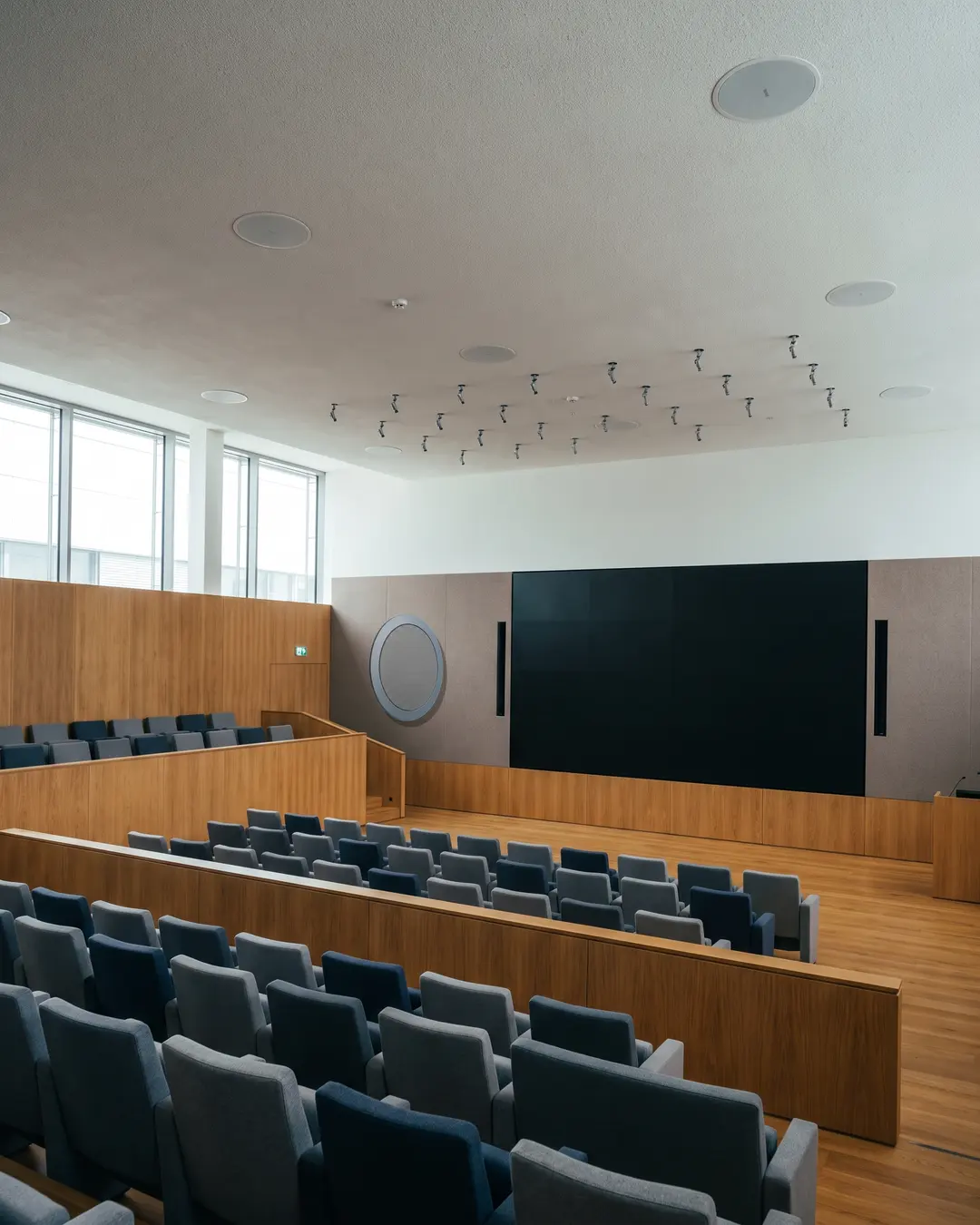
Distribution begins at the headend: satellite and terrestrial receivers gather there, and the channels leaving them pass through an encoder into IP packets. No separate coaxial riser reaches the rooms: picture and data share one copper and fibre backbone, so a new channel lands in the switches' capacity calculation, not at the antenna.
Copying one channel separately to every room exhausts bandwidth fast. Multicast reverses that: the source sends a stream once and the network replicates it only onto legs where an endpoint asked for that channel. Without IGMP snooping the stream floods every port, and the Wi-Fi side collapses first. On-demand content behaves the opposite way — each viewer takes a copy of their own, so load grows with every simultaneous viewer.
Loss shows more than delay: dropped packets leave blocks of corruption on the screen. Broadcast traffic therefore travels in its own VLAN, queues behind a priority marking, and inter-switch links are sized to the simultaneous channel count. Moving the encoder to H.265 carries the same picture at a lower rate, provided the endpoint supports that decoder.
The endpoint and channel policy
The screen in a room either runs its own client or takes a set-top box behind it; PoE feeds either and settles the wall socket. Channel lists differ by endpoint: a suite and a standard room, a patient room and a staff area, a lobby and a conference floor see different ones. Middleware builds the list from the state of the room, ordering a welcome screen, in-house channels, recorded content and outside broadcasts into one interface.
Which endpoints may open licensed channels belongs to the same policy. The wait when changing channel comes from the endpoint joining a stream and waiting for a key frame; shortening it is an encoder setting. Duplicating the headend and the distribution path is a separate decision, because a failed encoder darkens every screen it feeds.
- ANALYSIS & DISCOVERY
- SYSTEM ARCHITECTURE
- ENGINEERING DESIGN
- IMPLEMENTATION & INTEGRATION
- TESTING & COMMISSIONING
- SUPPORT & CONTINUITY