PROJECT
Airbnb and Short-Term Accommodation Solutions
This is not a live customer reference — it is an illustrative example scenario.
AIRBNB & SHORT STAY
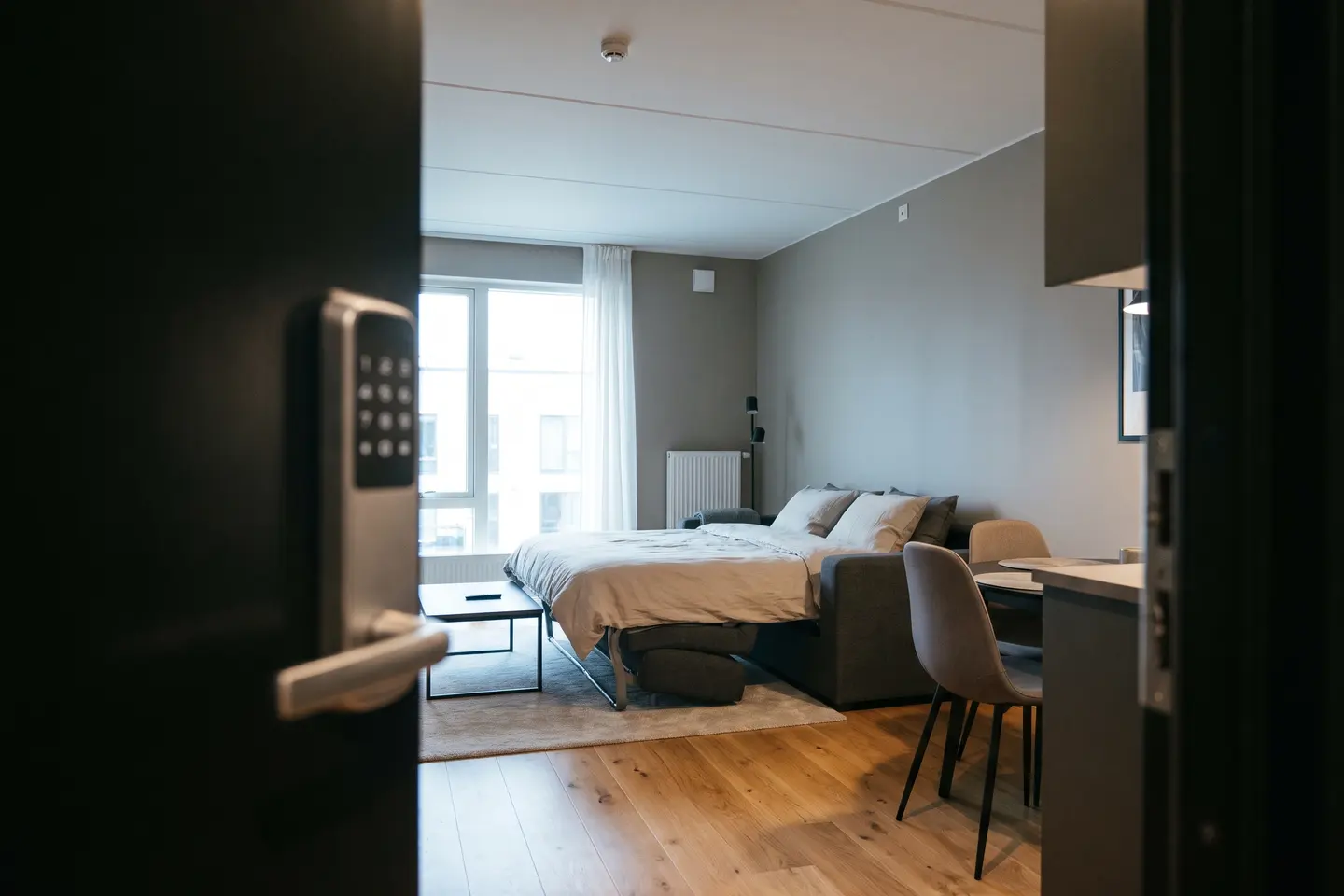
In a flat with no reception desk, the operation rests on a key that is born by itself and dies by itself. Once the reservation window closes, nobody collects a card, cancels a code or changes the lock; authority ends because it has expired. Short-stay design is built around that lifecycle.
Letting the lock validate offline is the decisive choice. Where the code is generated from the reservation period itself, the door admits the guest even while the cloud is out of reach. Battery follows the same logic: its state has to be visible before it runs out, and a mechanical fallback has to exist under every condition.
When the door does not open
Remote operation is tested at the moment the door stays shut. A guest arriving late at night faces nobody, so the failed attempt itself has to reach the operator as data. A voice channel, a fresh code and, as a last resort, remote opening close the incident before it grows.
Remote opening is also the riskiest privilege in the arrangement, precisely because it is the useful one. Without a record of who opens which door and when, neither side holds evidence in a dispute. Where that privilege sits, and when it may be used, are settled before any device is chosen.
Heating an empty flat
The gap between two stays is where energy is actually lost. A flat whose setpoint is never lowered is heated for days with nobody inside. The scheme is tied here to the calendar, not to a motion sensor: a sleeping guest is motionless while the flat is occupied, and occupancy comes from the reservation. The lowered setpoint keeps a floor of its own, because an empty flat allowed below the frost and humidity thresholds produces a maintenance problem far more expensive than the heating it avoids.
The values watched remotely are deliberately few: door and lock state, battery, power, indoor temperature and network visibility. That small set is enough to tell whether somebody has to be sent out. No CCTV sits inside the flat; imaging makes sense only on the shared entrance line, and retention is decided against that purpose alone.