PROJECT
Military Facility and Border Security Infrastructure
This is not a live customer reference — it is an illustrative example scenario.
DEFENSE & BORDER SECURITY
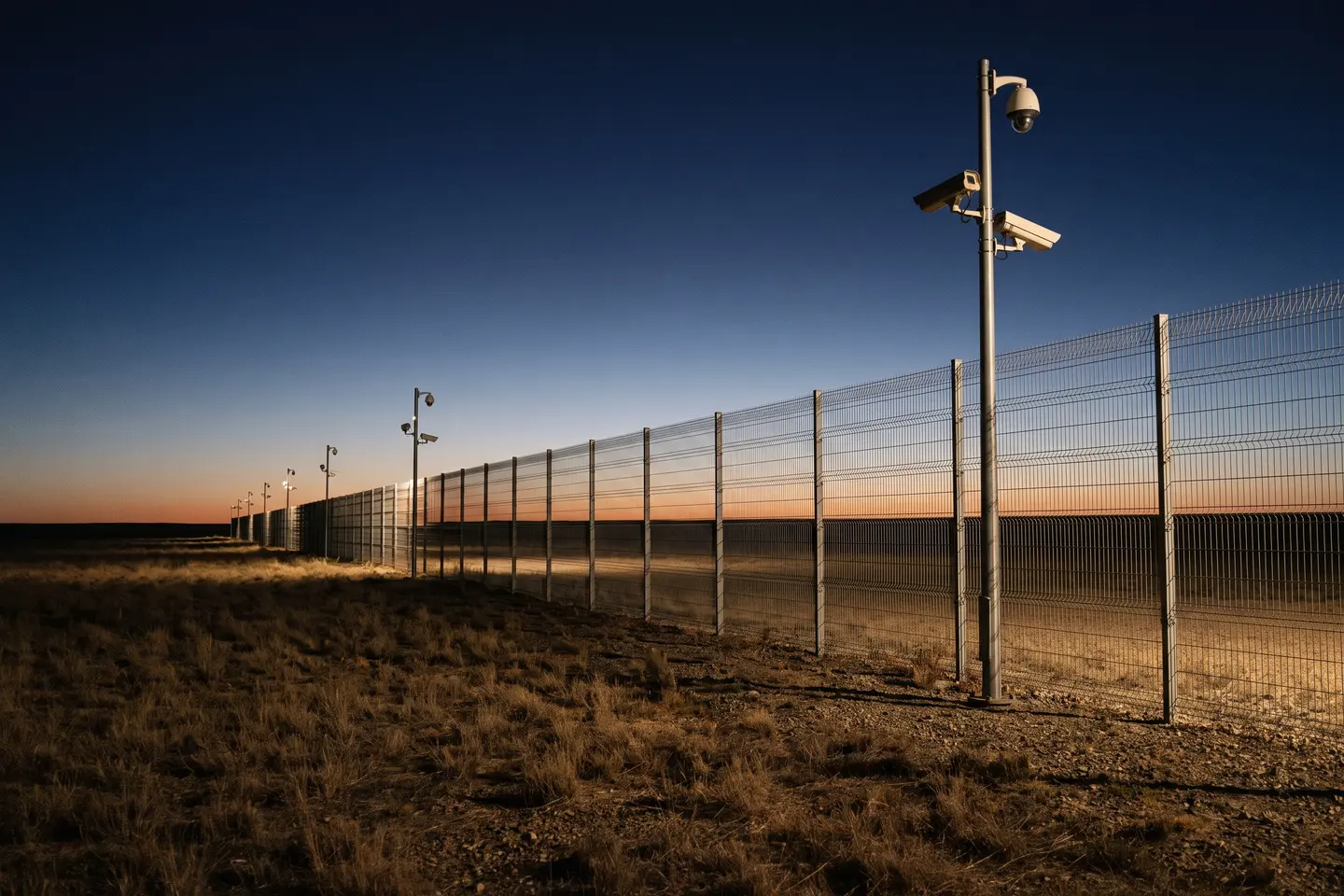
A detection scheme along a long unlit line is judged not by how many intrusions it catches but by how often it wakes a human for nothing. Vegetation moving in the wind, rain, drifting litter and animals crossing at night account for most of what the line reports. Filtering that noise before it reaches an operator is the real work of the design.
Detection and verification are separate layers
Radar gives the bearing and distance of a moving target in darkness and closed weather; it does not say what that target is. Thermal detection sees a heat signature without lighting, and gives no detail. Identity is decided at the PTZ CCTV unit cued to the event coordinates, and in the end by the operator. Overlap between layers is not surplus here but the method itself.
Rule sets change along the line: wooded stretch, open ground and roadside cannot run on the same thresholds. A threshold is built on target size, speed, direction and how long the line stays occupied. Anything resting on motion alone raises the same stretch on every windy night, and such an alarm is muted early and never turned back on.
The decision made at the gate
Traffic is heaviest at the gate. LPR reads the plate, access control confirms the authority on the card, and the barrier lifts only where the two answers agree. The real design question appears when the link to the command centre drops: deciding locally at the gate keeps movement from stopping, while staying closed takes the side of doubt. That choice belongs to the operating rule of the facility rather than the device, and it is written down before commissioning.
At the command centre events sit on a map, not a list, so an operator sees where before what. Voice between gate, patrol and centre belongs to the same arrangement, because verification more often ends by asking the person standing there than by image.
The share of weather and terrain
Heavy fog, snow and hard rain shorten thermal range, and wet vegetation disturbs radar returns. Under those conditions the answer is not a better device but knowing which stretches go blind and planning the overlap around them. The same measure applies to cable: where the fibre along the line closes into a ring, a cut at one point leaves no stretch dark.